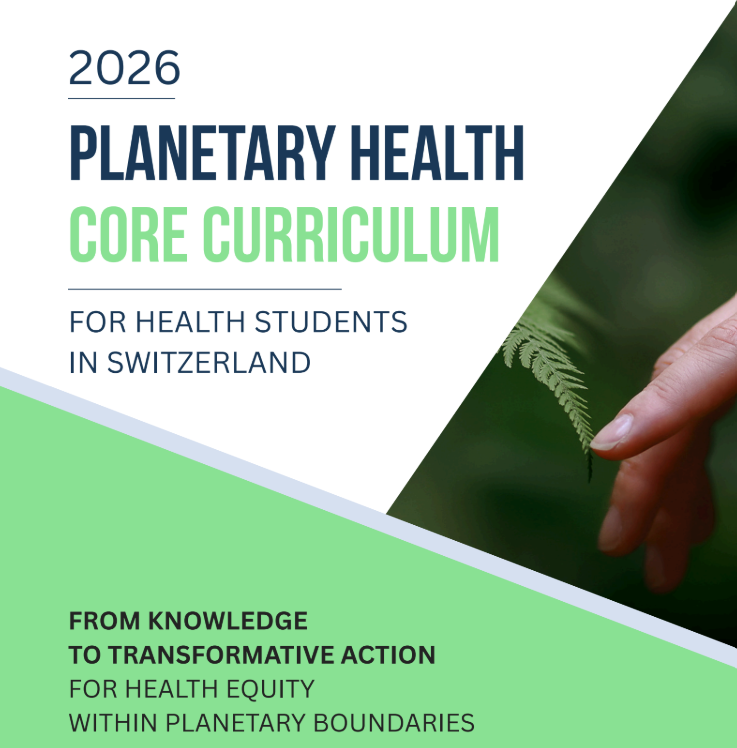
The Planetary Health curriculum was formally endorsed and published in July 2026.
The curriculum aims to prepare health professionals to:
- recognise and act on the systemic links between environment, health, political, social and economic systems and promote co-benefits;
- advocate for health equity within planetary boundaries;
- actively contribute to the socio-ecological transformation; and
- co-create healthcare that respects the planet’s ecological limits and fosters resilience.
Read the full version and the summary here:
For medical studies:
All learning outcomes are mapped with the new PROFILES catalogue. This mapping can help the medical faculties to implement the newly introduced environmental aspects of PROFILES 2 in their curriculum.
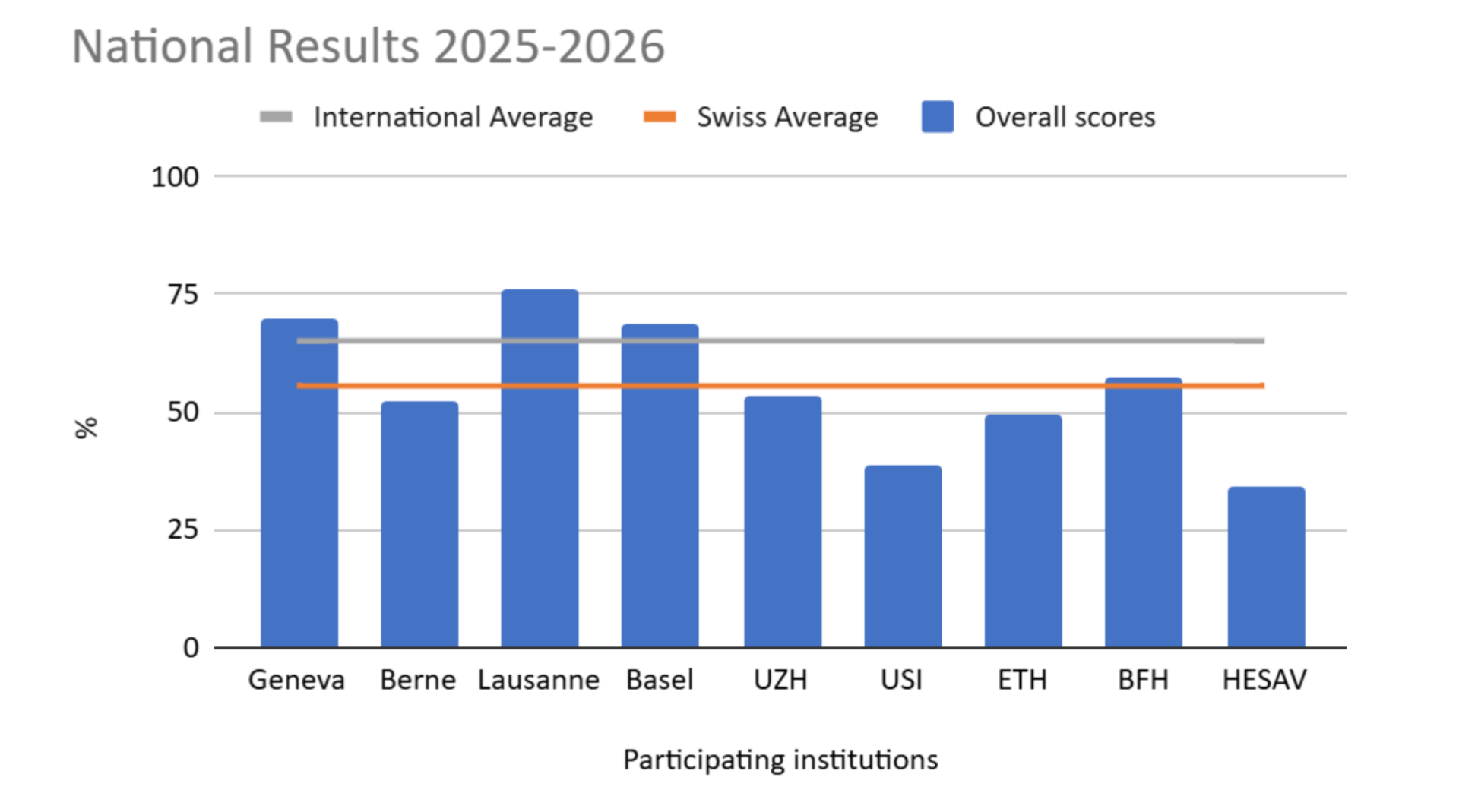
Planetary Health Report Card 2026
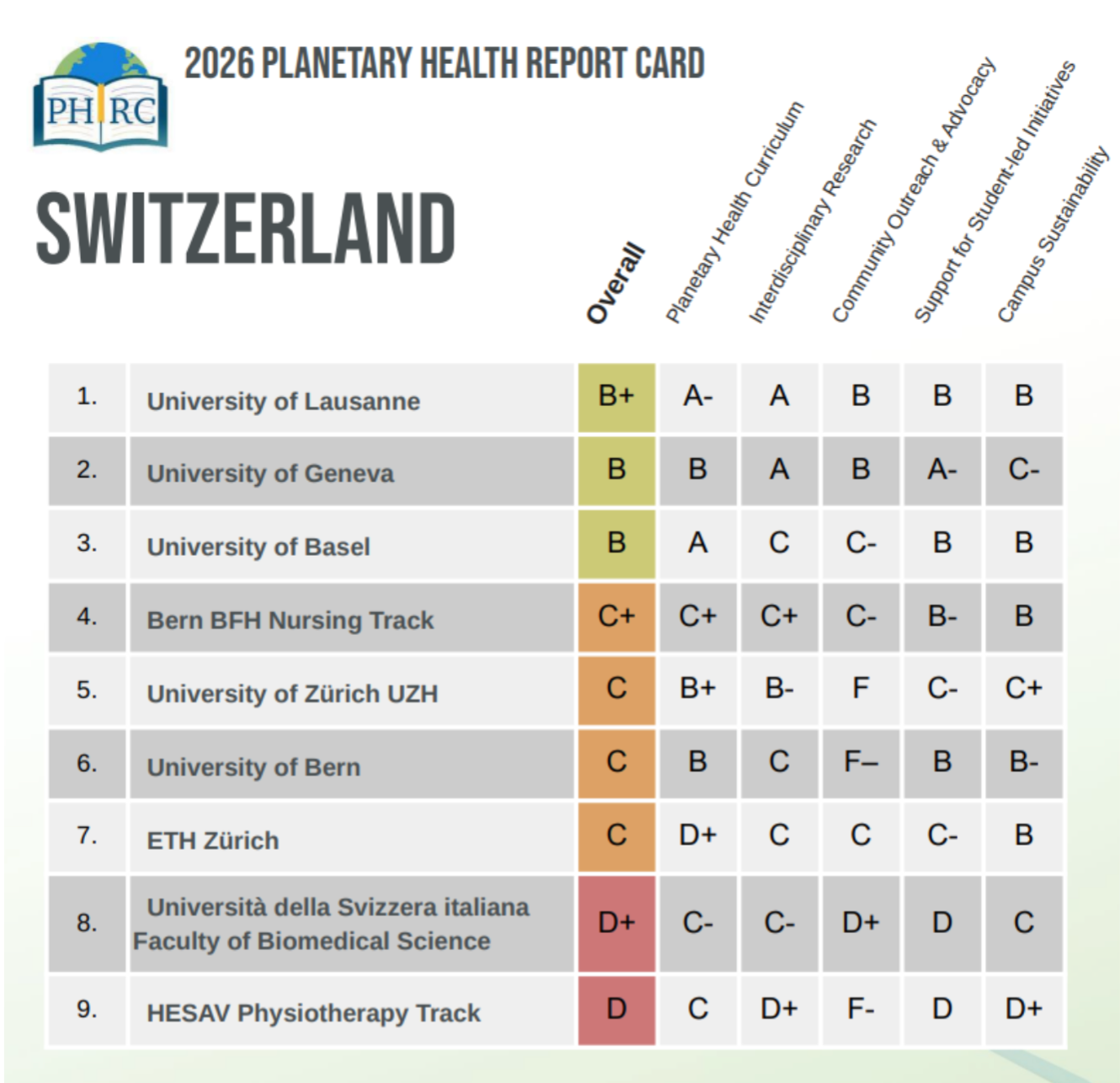
The 2026 edition of the Planetary Health Report Card Medicine - PHRC highlights Switzerland’s growing commitment to integrating Planetary Health into medical education. This student-led initiative evaluates health care schools worldwide on their efforts to prepare future health professionals for the environmental challenges impacting human health.
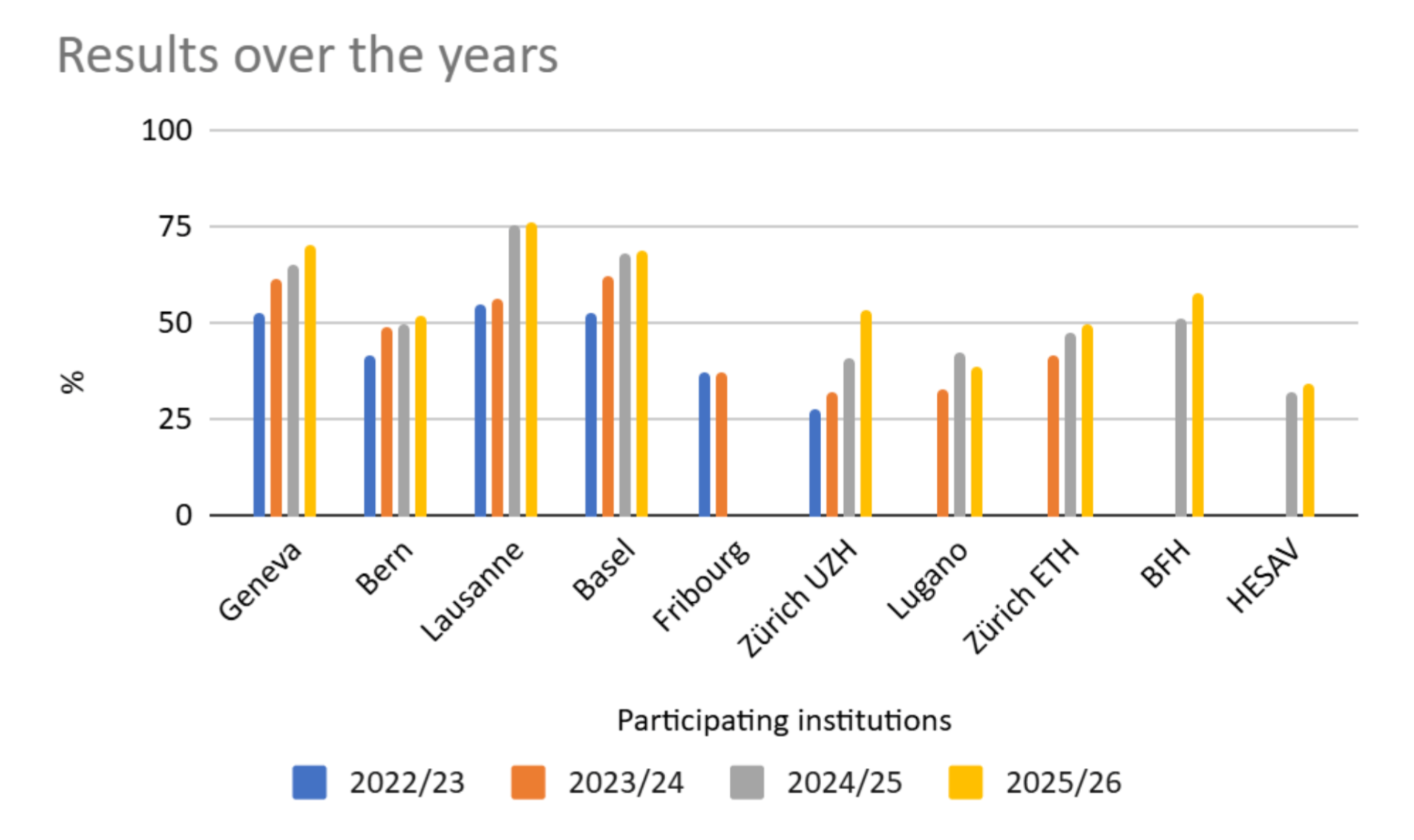
The results show steady progress, particularly in curriculum development and student-led initiatives. Several institutions have introduced new teaching modules on climate-related health risks, sustainable healthcare practices, and environmental determinants of health.
While the 2026 results reflect positive momentum, there is still room for growth, especially in interdisciplinary collaboration and institutional support.
Check the status of your curriculum
Has your institution completed the Planetary Health Report Card?
The report card is available for various health study programs, such as nursing, medicine, pharmacy and physiotherapy.
E-Learning
- We’re currently developing a national E-Learning on Planetary Health, accessible for all health students, teachers, professionals & individuals. It will be published here in 2027.In the meantime you can have a look at existing E-Learnings from Switzerland and abroad in our useful resources.

Transformative Education
What is transformative education?
Transformative education understands learning as a process of critical reflection that can lead to shifts in perspectives, attitudes, the understanding of professional roles and in actions. Drawing on Mezirow’s theory of transformative learning, it moves beyond the mere transmission of knowledge and links facts to emotions. It thereby explicitly engages learners in challenging taken-for-granted assumptions, rethinking societal norms, values, their role in the world and the human relation to the more-than human world.
Consequently, transformative education facilitates broader socio-ecological transformation by empowering individuals to recognise their potential for impact and take meaningful action for health at individual, institutional and societal levels (1-2).
Read more about the relevance of transformative education, the three levels of change and teaching examples below.
Merzel CR. Pedagogy for Transformative Teaching and Learning. Pedagogy in Health Promotion. 2023;9(4):231-233. doi:10.1177/23733799231208392
Van Schalkwyk, S. C., Hafler, J., Brewer, T. F., Maley, M. A., Margolis, C., McNamee, L., Meyer, I., Peluso, M. J., Schmutz, A. M., Spak, J. M., Davies, D., & the Bellagio Global Health Education Initiative. (2019). Transformative learning as pedagogy for the health professions: A scoping review. Medical Education, 53(6), 547–558. https://doi.org/10.1111/medu.13804
Background: Why is transformative education important for Planetary Health?
Education plays a pivotal role in ensuring that learners see themselves not only as future health professionals but also as agents of change in shaping just, resilient and sustainable health systems and societies (3). Transformative education, according to UNESCO, emphasises learner agency, collective learning, systems thinking and future orientation. Reflection, dialogue, emotional engagement and action are therefore treated as core pedagogical elements rather than optional additions. In this, it builds on the concept of “head, heart and hand” introduced by the Swiss paedagogic Johann Heinrich Pestalozzi (1746-1828). Including these three elements allows educational processes to bridge the gap from knowledge to transformative action.
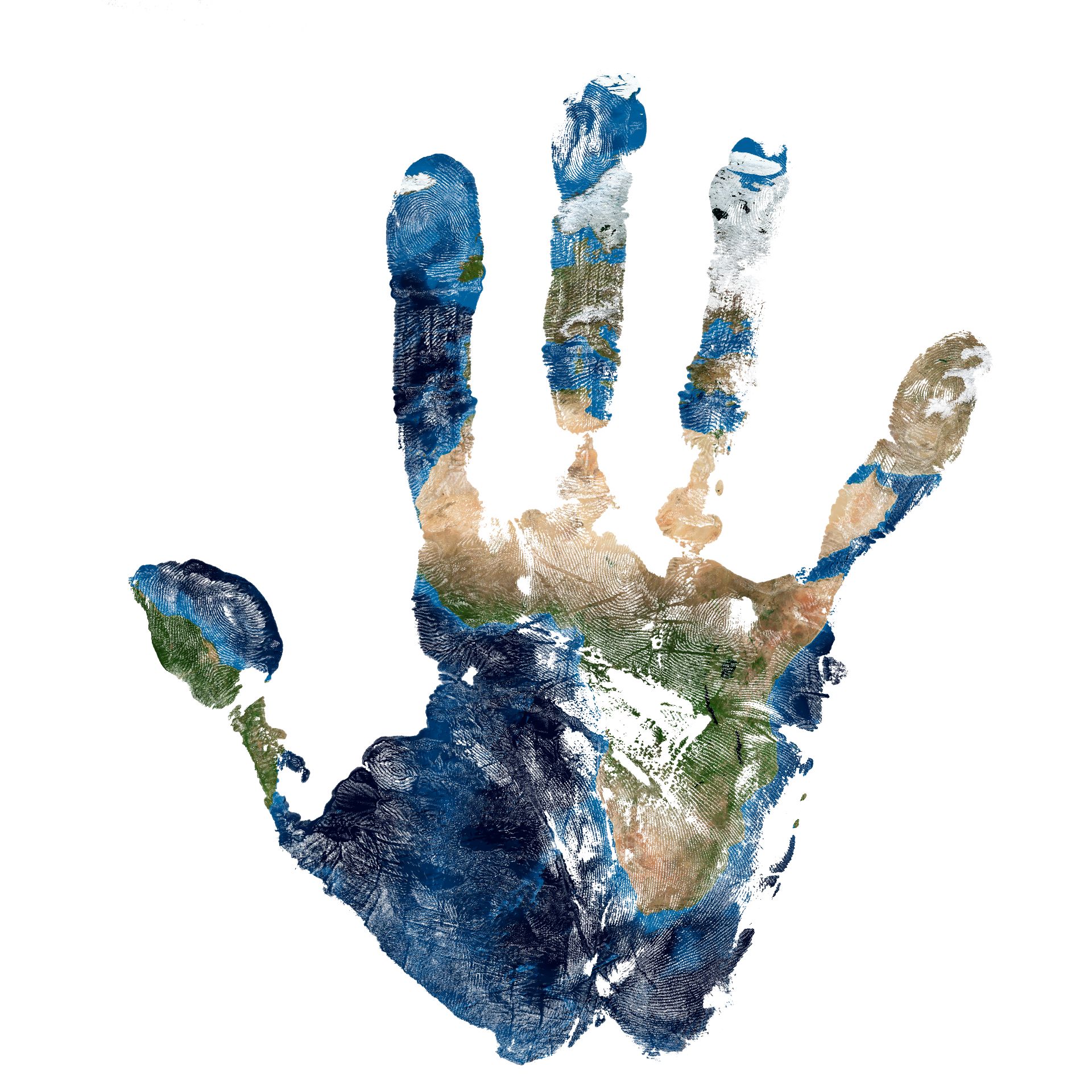
Thus, transformative education is central to Planetary Health. It is more than the transmission of knowledge and forms an intentional, conscious process that engages both the cognitive and affective domains. Learners are encouraged to critically examine their prior assumptions, worldviews and biases, allowing them to develop new interpretations of health, society and the environment. This form of learning acknowledges the complexity and uncertainty of the world and invites students to question established frames of reference (1-3).
Merzel CR. Pedagogy for Transformative Teaching and Learning. Pedagogy in Health Promotion. 2023;9(4):231-233. doi:10.1177/23733799231208392
Van Schalkwyk, S. C., Hafler, J., Brewer, T. F., Maley, M. A., Margolis, C., McNamee, L., Meyer, I., Peluso, M. J., Schmutz, A. M., Spak, J. M., Davies, D., & the Bellagio Global Health Education Initiative. (2019). Transformative learning as pedagogy for the health professions: A scoping review. Medical Education, 53(6), 547–558. https://doi.org/10.1111/medu.13804
Howard, C., Marks, R. (2024). Roadmap for Planetary Health and Sustainable Health Systems. AFMC
The principles of transformative education align with other emerging frameworks such as the Inner Development Goals which emphasise personal and relational capacities (e.g. being, thinking, relating, collaborating and acting). They are also reflected in the Future Skills framework, which highlights competencies such as self-efficacy, systems thinking, anticipatory skills and transformative action as essential for navigating complex global challenges (4,5).
Inner Development Goals. n.d. Inner Development Goals Framework. Available at https://innerdevelopmentgoals.org/framework/ [cited 26 March 2026].
Ehlers, Ulf-Daniel. Future skills: The future of learning and higher education. BoD–Books on Demand, 2020.
Importantly, transformative Planetary Health Education requires epistemic plurality.
Dominant biomedical and Eurocentric paradigms are complemented by indigenous and other non-Western ways of knowing that emphasise relationality, reciprocity, and interconnectedness between human and more-than-human health. Indigenous frameworks, such as relational concepts of health, land-based knowledge, and the principle of responsibility to future generations, offer valuable perspectives for reimagining health beyond extractive and growth-oriented models. By highlighting the importance of integrating multiple knowledge systems with humility and respect, transformative Planetary Health Education aims to equip future health professionals with the capability of ethical reflection, intercultural dialogue and transformative action in diverse contexts.
Three levels of change
Transformative education links individual, institutional and political levels of change
- At the micro level, learners can change their behaviours, reduce their ecological footprint and make sustainable choices. These often have health co-benefits e.g. active transport, plant-rich diets.
- At the meso level, learners can use their societal roles, e.g. as health professionals to advocate for changes beyond the individual level, e.g. for support of active and public transport to the workplace, or healthy food service
- At the macro level, health professionals can engage in public and political discourse, advocate for climate-resilient health systems, sign petitions, talk to politicians, use the means of direct democracy etc.
Links
Useful Resources

Planetary Health Education
Education for Sustainable Development
Planetary Health Research
Planetary Health Action
Planetary Health Policy
One Health
Mental Health & Environmental Psychology
E-Learnings
All Health Professions
Human Medicine
Physiotherapy
Research Publications on Planetary Health Education
Health Services
Doctors
Nurses
Psychologists/Psychiatrists
Pharmacists
Nutritionists
Podcasts
Videos/Webinars