
Human health is inseparably linked to the health of Earth’s ecosystem and vice-versa – Planetary Health examines this interdependence. Today’s accelerating environmental crises, namely climate change, biodiversity loss and pollution, are already eroding the foundations of well-being and social equity. These challenges represent the most significant health threats of the 21st century. Yet they also present an opportunity to rethink how we live, learn and act. Planetary Health is both a solutions-oriented scientific field and a social movement dedicated to advancing health equity and well-being within the planet’s ecological limits, ensuring a safe and just future for all. (1-3)
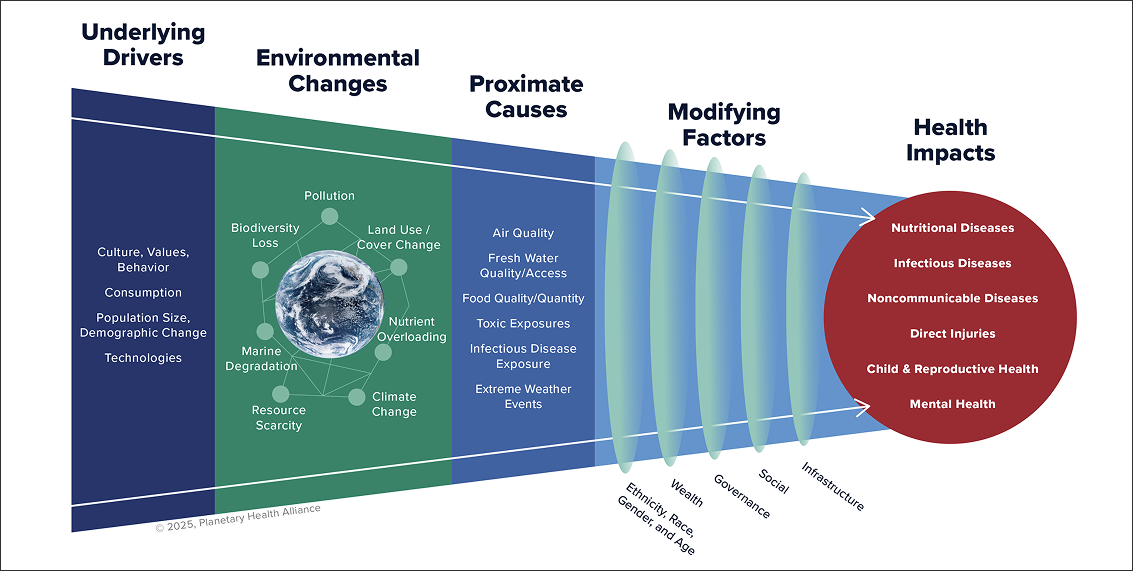
Addressing these challenges requires more than technical solutions: it calls for a profound cultural, societal and economic transformation. Health professionals, in particular, hold a unique responsibility to inspire and mobilise individuals, communities, and institutions for a healthier planet and all its inhabitants (4). Education is central to this process. In the context of Planetary Health, this means preparing health professionals to:
-
Recognize the systemic links between environment, health, political, social and economic systems;
-
Advocate for health equity within planetary boundaries; and
-
Actively contribute to the change and co-create health care that respects the planet’s ecological limits (5).
Eurocentric health education often focuses on a sickness-based system instead of a health-based one, concentrating on individual risk factors and clinical care. While this is important, it is not the full picture. Planetary Health expands this lens by integrating ecological, social, political and commercial determinants of health, taking a transdisciplinary perspective and putting justice at its centre. Taking a transformative approach to teaching Planetary Health means going beyond cognitive learning to nurture values, self-efficacy, empathy, critical thinking and participatory skills. This empowers health professionals to serve as trusted voices and change agents in their communities (6).
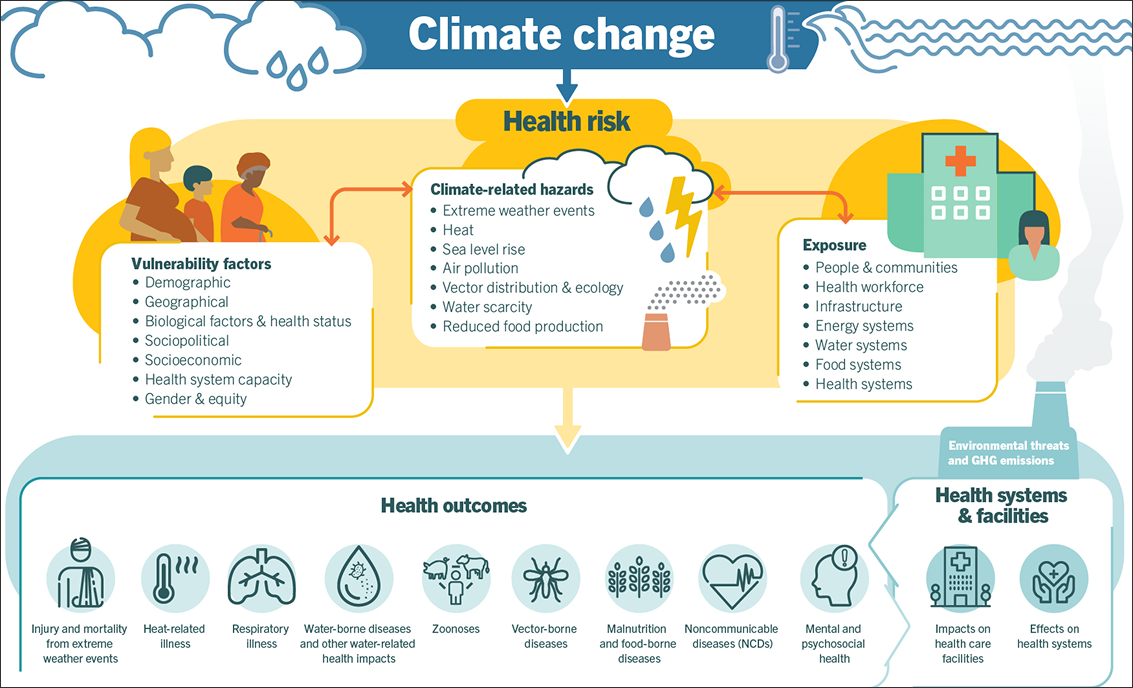
Momentum is growing worldwide. Planetary Health Education has been rapidly expanding across the globe and its importance for health curricula is recognized internationally: The AMEE’s Consensus Statement on Climate Change & Health highlights the urgency of curricular transformation, the World Health Organization (WHO), World Medical Association (WMA) and International Council of Nurses (ICN) are all calling for health workers to be educated on Planetary Health.
In Switzerland, initiatives such as the Planetary Heath strategy of the Swiss medical association FMH, the strategy of the Swiss nursing association SBK/ASI "Pflege 2030/Soins 2030", the revised PROFILES catalogue for medical education, and the work of the ETHICH consortium reflect this shift. Together, these strategies emphasize the responsibility and opportunity for health education to lead the way in addressing the socio-ecological crisis. This is exactly where the PHUSE initiative comes in. Discover more about our work here.
Links
References
Planetary Health Alliance. (2025). Planetary Health Alliance. Planetary Health Alliance. https:/www.planetaryhealthalliance.org/
Whitmee, Sarah, et al. "Safeguarding human health in the Anthropocene epoch: report of The Rockefeller Foundation–Lancet Commission on planetary health." The lancet 386.10007 (2015): 1973-2028.
Horton, Richard, et al. "From public to planetary health: a manifesto." The Lancet 383.9920 (2014): 847.
Traidl-Hoffmann, C., Schulz, C., Herrmann, M., & Simon, B. (2021). Planetary Health—Klima, Umwelt Gesundheit im Anthropozän. https://www.researchgate.net/publication/354919730_Planetary_Health_-_Klima_Umwelt_Gesundheit_im_Anthropozan
Van Schalkwyk, S. C., Hafler, J., Brewer, T. F., Maley, M. A., Margolis, C., McNamee, L., Meyer, I., Peluso, M. J., Schmutz, A. M., Spak, J. M., Davies, D., & the Bellagio Global Health Education Initiative. (2019). Transformative learning as pedagogy for the health professions: A scoping review. Medical Education, 53(6), 547–558. https://doi.org/10.1111/medu.13804
World Health Organization (WHO). (2018). COP24 special report: Health and climate change. https://www.who.int/publications-detail-redirect/9789241514972
Glossary
Here you find some definitions about Planetary Health:
- Agency/ Agents of Change
Agency refers to the capacity of individuals and groups to act intentionally and effectively to influence social, institutional, and systemic conditions. In Planetary Health Education, developing competencies as agents of change enables health professionals to translate knowledge and values into meaningful action for health equity within planetary boundaries. - Epistemic Plurality
Epistemic plurality refers to the recognition and inclusion of multiple ways of knowing, including scientific, Indigenous, local, and experiential knowledge. In Planetary Health Education, epistemic plurality supports critical reflection on dominant paradigms and can foster more inclusive and just approaches to health. - Health Advocacy
Health advocacy refers to the actions of health professionals, individually and collectively, to influence policies, practices and social conditions that determine health and well-being, with the aim of improving health outcomes, protecting vulnerable populations and reducing inequities. In the context of Planetary Health, it includes engaging with social, commercial and ecological determinants of health, promoting environmental justice and supporting the systemic transformations needed to safeguard health within planetary boundaries. - Health Co-Benefits
Health co-benefits of environmental action are interventions or policies that simultaneously create positive outcomes for human health, environmental sustainability and social well-being. Examples include interventions or policies strengthening active mobility, public transport, sustainable diets and access to green spaces. - Health Equity
Health equity refers to fair opportunities for all people to attain their highest possible level of health, which requires removing avoidable and unjust differences in health and their underlying determinants. In the context of Planetary Health, it includes intergenerational and interspecies justice and recognises that environmental degradation and climate change disproportionately affect marginalised and historically disadvantaged communities as well as future generations. - Indigenous Knowledge Systems
Indigenous knowledge systems are place-based, relational ways of knowing developed through long-standing relationships between Indigenous peoples and their environments. These systems emphasise interconnectedness, reciprocity, responsibility and respect for more-than-human life, and contribute essential perspectives to health and planetary stewardship. -
More-than-human
More-than-human describes an understanding that human life is inseparable from and dependent on a broader web of living and non-living systems, including animals, plants, ecosystems and natural processes. In the context of Planetary Health, it highlights the interdependence between human and non-human systems and encourages approaches that take into account the integrity and well-being of the entire Earth system, rather than focusing solely on human health. - Planetary Boundaries
Planetary boundaries describe scientifically defined limits within which humanity can safely operate to maintain Earth system stability. Exceeding these boundaries increases the risk of large-scale, potentially irreversible environmental and health impacts. As of 2026, seven out of nine planetary boundaries have been transgressed. -
Planetary Crises
Planetary crises refer to the interconnected global environmental challenges that threaten the stability of the Earth system and human well-being, most prominently climate change, biodiversity loss and pollution. These crises share common drivers, reinforce one another and together undermine ecosystems, health and the conditions necessary for sustainable and equitable societies.
- Planetary Health
Planetary Health examines the interdependence between Earth’s ecosystems and human health. The human-made planetary crises, namely climate change, biodiversity loss and pollution, pose the greatest existing threat to human health of the 21st century. Planetary Health is both a solutions-oriented scientific field and a social movement dedicated to advancing health equity and well-being within the planet’s ecological limits, ensuring a safe and just future for all. - Post-Growth
Post-Growth describes economic and societal approaches that move beyond continuous economic growth as a primary goal. Instead, this framework emphasises human well-being, ecological sustainability and social justice within planetary boundaries. In the context of Planetary Health, Post-Growth perspectives highlight sufficiency, care and equity as foundations for health systems that operate within ecological limits. - Social, Ecological and Commercial Determinants of Health
The determinants of health encompass the conditions in which people are born, grow, live, work, and age. Social determinants include socioeconomic and political factors; ecological determinants include environmental conditions such as climate, biodiversity, and pollution; commercial determinants refer to corporate practices, market forces and power structures that influence health. -
Social Tipping Points
Social tipping points refer to critical thresholds within social systems at which relatively small changes in behaviours, norms, policies, or technologies can trigger rapid, large-scale, and self-reinforcing societal transformations. -
Socio-Ecological Transformation
Socio-ecological transformation refers to the fundamental restructuring of social, economic and political systems to ensure human well-being within planetary boundaries. It involves shifts in values, institutions, power relations, and patterns of production and consumption. -
Sufficiency
Sufficiency refers to the principle of reducing resource use and consumption to levels compatible with ecological limits while ensuring that basic human needs and well-being are met for all. In Planetary Health, it includes avoiding overdiagnosis and overtreatment, prioritising appropriate and effective care and supporting lifestyles and systems that promote health within planetary boundaries. -
Sustainable Healthcare
Sustainable healthcare is the provision of high-quality care that meets current health needs while minimising environmental harm, respecting planetary boundaries, promoting social equity and preserving resources for future generations. It includes prevention-oriented care, low-carbon clinical practice, ethical procurement and resilient health systems. -
Systems Thinking
Systems thinking is an approach to understanding complex problems by examining relationships, feedback loops and underlying structures rather than isolated events. In Planetary Health, systems thinking supports both the identification of root causes and the design of interventions that account for interconnected social, ecological and economic factors. - Transformative Education
Transformative education is an approach to learning that challenges assumptions, fosters reflection of one's own perspectives, values and professional identities, links facts to emotions and empowers learners to act as agents of change. In health professions education, it supports learners in questioning dominant assumptions and developing the capacity to contribute to systemic change. -
Well-Being Economy
Well-being economy is an economic model that builds on the Post-Growth framework and prioritises well-being over economic growth, aiming to meet decent living standards, strengthen equity and regenerate ecosystems. In Planetary Health, the well-being economy provides a framework for aligning health systems, public policy and economic activity with long-term health equity and ecological resilience.